
Choosing between pool patios vs concrete is one of the most important decisions homeowners face when designing a pool area. The surface surrounding your pool impacts safety, durability, maintenance, and long term value. While concrete has been a traditional choice for decades, modern pool patios built with pavers offer structural flexibility and design advantages. Understanding the differences helps you make an informed investment that performs well for years.
Understanding the Basics
Before comparing performance, it is important to clarify what each option involves.
What Is a Concrete Pool Deck?
A concrete deck is typically a poured slab installed over a compacted base. It may be broom finished, stamped, or stained for decorative appeal. Expansion joints are cut to control cracking, and sealers may be applied for protection.
What Is a Pool Patio?
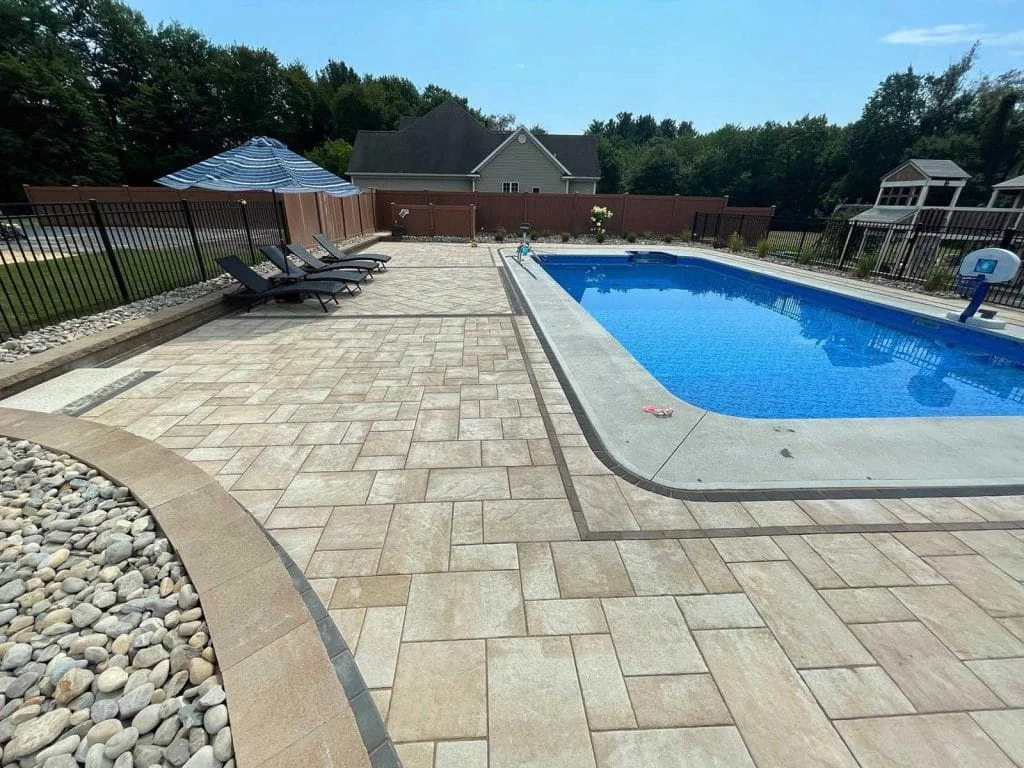
A pool patio is usually constructed with interlocking concrete pavers or natural stone installed over a layered aggregate base. Individual units lock together and are secured with edge restraints and joint sand.
The core difference between pool patios vs concrete lies in structural behavior and long term maintenance.
Durability and Structural Performance
Pool environments present unique challenges. Water exposure, chemical splash out, and temperature fluctuations all stress surface materials.
Concrete Performance
Concrete slabs are rigid. Over time, soil movement, freeze thaw cycles, and improper base preparation can cause cracking. Even when expansion joints are installed correctly, cracks are common within several years.
According to the American Concrete Institute, concrete naturally shrinks as it cures, which contributes to cracking potential. While reinforcement reduces structural failure, it does not eliminate surface cracks.
Repairs often require patching or slab replacement, which can create visible color inconsistencies.
Paver Patio Performance
Interlocking pavers distribute loads across multiple units. Because they are modular, they can shift slightly without cracking. If settling occurs, individual sections can be lifted, re leveled, and reset.
The Interlocking Concrete Pavement Institute notes that properly installed paver systems can withstand heavy loads and maintain structural integrity for decades when built over a compacted base.
From a structural standpoint, pool patios often offer more long term flexibility.
Safety and Slip Resistance
Safety is critical around pools, especially for families with children.
Concrete Surface Safety
Standard broom finished concrete provides moderate traction. However, stamped or sealed surfaces can become slippery when wet. Over time, smooth areas may develop as the surface wears down.
Surface coatings can improve traction, but they require maintenance and reapplication.
Paver Surface Safety
Many pavers are manufactured with textured surfaces that maintain traction when wet. Joint spacing between pavers also helps improve grip underfoot.
Certain materials, such as travertine, remain cooler in direct sunlight compared to traditional concrete, reducing the risk of burns during summer months.
When comparing pool patios vs concrete for slip resistance, textured pavers often provide a practical advantage.
Heat Retention and Comfort
Surface temperature significantly affects poolside comfort.
Concrete absorbs and retains heat. Dark colored or stained slabs can become extremely hot in warm climates. Cooling treatments exist, but they increase upfront costs.
Pavers come in a wide range of lighter tones that reflect sunlight more effectively. Natural stone options such as limestone or travertine tend to stay cooler due to density and porosity characteristics.
Homeowners in hotter regions frequently prefer pavers for this reason alone.
Aesthetic Flexibility
Design freedom is another major factor.
Concrete Design Options
Concrete can be:
- Broom finished
- Stamped with patterns
- Colored with pigments
- Stained after curing
While decorative options exist, cracking can disrupt visual consistency over time.
Paver Design Options
Pool patios allow:
- Multiple laying patterns
- Mixed color blends
- Contrasting borders
- Curved layouts
- Integrated steps and coping
Because pavers are individual units, detailed design elements are easier to achieve. If a section is damaged, it can be replaced without affecting the entire deck appearance.
For homeowners seeking custom design flexibility, pool patios typically offer greater versatility.
Maintenance and Repairs
Maintenance costs accumulate over time, so this factor deserves careful consideration.
Concrete Maintenance
Concrete decks may require:
- Crack filling
- Pressure washing
- Resealing every few years
- Surface resurfacing
When cracking becomes extensive, replacement is often the only long term solution.
Paver Maintenance
Paver patios require:
- Occasional joint sand replenishment
- Periodic cleaning
- Optional sealing for color enhancement
If a section settles or stains, it can be removed and reset. This modular repair capability often reduces lifecycle costs.
According to the National Association of Home Builders, homeowners increasingly favor materials that allow partial repairs rather than full demolition, especially in outdoor living spaces.
Installation Considerations
Installation quality significantly affects both systems.
Concrete installation involves forming, pouring, finishing, and curing. Weather conditions during the pour can influence surface integrity. Once cured, modifications are difficult.
Paver installation requires:
- Excavation to proper depth
- Geotextile fabric when needed
- Layered aggregate base compaction
- Bedding sand installation
- Precise paver placement
- Edge restraint anchoring
- Joint sand compaction
The base preparation stage is critical. Poor compaction leads to settlement regardless of surface material.
While paver installation is more labor intensive, it provides greater structural adaptability over time.
Cost Comparison
Initial cost often influences decisions.
Concrete is generally less expensive upfront, especially for basic broom finished slabs. Decorative stamping and coloring increase the price.
Paver patios typically cost more initially due to materials and labor. However, when comparing pool patios vs concrete over a 20 to 30 year period, repair flexibility and durability can offset higher initial investment.
Homeowners should evaluate total lifecycle cost rather than focusing solely on initial installation price.
Environmental Considerations
Permeable paver systems allow water to pass through joints into a specially engineered base. This can reduce runoff and support groundwater recharge.
The Environmental Protection Agency recognizes permeable pavement systems as effective tools for stormwater management in residential applications.
Traditional concrete slabs are impermeable unless specifically engineered otherwise.
For homeowners concerned with drainage and environmental impact, permeable paver options provide additional value.
Which Option Is Better?
The answer depends on priorities.
Choose concrete if:
- Budget is limited
- Design is simple and rectangular
- Minor cracking is acceptable
Choose a paver pool patio if:
- Long term durability is a priority
- You want flexible repairs
- Design customization matters
- You prefer enhanced traction and comfort
From a structural and design standpoint, many professionals lean toward pavers for high use pool environments.
Read also: Paver Patios for Backyard Transformations: Design to Installation
Choose the Right Pool Patio for Long-Term Performance
When comparing pool patios vs concrete, both options can serve as functional pool surrounds if installed properly. Concrete offers lower upfront cost and straightforward installation, while paver pool patios provide superior flexibility, repairability, and design versatility, especially in areas exposed to water and temperature changes.
A well-planned pool deck is not just a finishing touch—it is a structural investment that affects safety, comfort, and property value for decades. Take the first step today and reach out to The Patio Bros. to schedule a professional site evaluation and create a pool patio built to last.